
Cost of Living in Three Forks, Montana: The Complete 2026 Guide
By Jean White & Britney White, REALTORS® | Berkshire Hathaway HomeServices Montana Properties | Bozeman Real Estate.com
Quick answer: The cost of living in Three Forks, Montana runs roughly 11–21% above the national average, driven almost entirely by housing. Utilities, healthcare, and day-to-day transportation costs are close to or below the national average, and Montana’s lack of a state sales tax helps offset the premium. Compared to nearby Bozeman, Three Forks remains one of the more affordable entry points into the Gallatin Valley.
Anyone researching moving to Three Forks Montana is usually weighing the same trade-off: a smaller town with a lower price tag than Bozeman, set against fewer amenities and a longer drive to big-city conveniences. This guide breaks down exactly what that trade-off looks like in dollars — housing, utilities, groceries, healthcare, childcare, and taxes — and shows how Three Forks stacks up against its closest Gallatin Valley neighbors, Belgrade and Bozeman, so you can decide whether it fits your budget and your lifestyle.
Three Forks Montana Housing Prices
Housing is the single biggest driver of the cost of living in Three Forks, Montana, and it’s not close. Multiple independent cost-of-living indexes put Three Forks housing expenses well above the national average, even though the town’s overall population is small and the pace of life is slower than Bozeman. Buyers moving from out of state are often surprised that a rural Montana town can carry housing costs this far above the national baseline — but Three Forks sits inside the broader Gallatin Valley market, which has seen sustained demand from Bozeman-area buyers looking for more land, more space, and a quieter setting within commuting distance.
That said, context matters. Home prices in Three Forks are still meaningfully lower than in Bozeman itself, which continues to be Montana’s most expensive real estate market. For buyers priced out of Bozeman, Three Forks — along with Manhattan and Belgrade — remains one of the more attainable ways to put down roots in the Gallatin Valley without leaving the region entirely.
Rental inventory in Three Forks is limited compared to Bozeman, which can push rents higher than the town’s small-market reputation might suggest. Anyone relocating for work should start a housing search early and lean on a local agent who tracks Three Forks listings directly through the Big Sky Country MLS, since homes here can move quickly when they’re priced well.
Renting vs. Buying in Three Forks
Most households in Three Forks own rather than rent, which is typical for a small Montana town where the rental market is thin. That dynamic cuts both ways for newcomers: it means fewer apartment complexes and short-term rental options to choose from, but it also means the local housing stock leans toward single-family homes on larger lots — exactly what draws many buyers away from Bozeman’s condo-heavy inventory in the first place. Buyers who can move directly into ownership typically have an easier time in Three Forks than renters searching for a short-term foothold, since landlords and property managers are less common here than in a college town like Bozeman.
Utilities & Energy Costs
Utility costs in Three Forks generally track close to or slightly below the national average, which helps offset some of the housing premium. Winters in southwest Montana are long and can be genuinely cold, so heating costs climb from November through March, and homes with older furnaces or poor insulation will see that reflected in monthly bills. Electricity, natural gas, water, and trash service are all typically billed separately from what a buyer might be used to in a large metro area, so it’s worth budgeting for the full utility stack rather than a single combined bill.
Groceries & Everyday Expenses
Grocery prices in Three Forks run modestly above the national average, generally in the mid-single digits as a percentage. Three Forks has local grocery options, but residents who want more selection — specialty items, bulk shopping, or a wider range of restaurants — will often make the drive into Bozeman or Belgrade. That drive is worth factoring into a realistic monthly budget, both for gas and for the time it adds to routine errands.
Dining out is similarly limited compared to Bozeman, which has a much larger restaurant scene tied to Montana State University and a bigger population base. Three Forks residents who eat out regularly should expect to do at least some of that spending in Bozeman or Belgrade rather than in town, which is worth building into a monthly budget alongside the grocery line item.
Transportation & Commuting
Three Forks sits along I-90, which makes commuting to Bozeman, Belgrade, or Manhattan for work relatively straightforward, though it does add real miles and minutes to a daily routine. Most residents drive; public transit options are minimal outside of Bozeman’s in-town network. Gas prices in Three Forks track close to the national average, but households commuting regularly into Bozeman should plan for higher annual transportation spending than they might see living closer to the job center.
Healthcare Costs
Healthcare costs in Three Forks tend to run at or slightly below the national average, which is a notable contrast to the housing side of the ledger. Bozeman Health and other regional providers serve the Gallatin Valley, so residents of Three Forks typically drive 30–40 minutes for specialized care, urgent care, or hospital services, while more routine care may be available closer to home.
Childcare Costs
Families relocating to Three Forks should budget carefully for childcare, since rural Montana towns generally have fewer licensed providers than a larger city like Bozeman. Limited local supply means slots can fill up well in advance, and full-time care for two children can carry an above-average price tag once travel to a provider outside of town is factored in. Families who plan to lean on in-home care, a nanny share, or a stay-at-home arrangement will find that this cost pressure matters less, but two-income households commuting to Bozeman should treat childcare availability as a real factor in the decision, not just a line-item cost.
Local Income & Job Market Context
Median household income in the Three Forks area tends to run above both the Montana state average and the national average, which helps explain how residents absorb the higher housing costs. A meaningful share of the local workforce commutes to Bozeman, Belgrade, or Manhattan for work, since Three Forks itself has a smaller base of local employers concentrated in agriculture, trades, tourism, and small business. Unemployment in the area is typically low, and the broader Gallatin Valley job market has continued to expand alongside population growth, which supports home values even as it keeps competition for housing tight.
Taxes in Three Forks & Montana
One of Montana’s biggest financial advantages shows up here: there is no state or local sales tax anywhere in Montana, including Three Forks. That’s a real, ongoing savings on everything from groceries (where taxed) to vehicles to home goods, and it partially offsets the higher cost of housing. Property tax rates in the Three Forks area are relatively moderate by national standards, though the total property tax bill still depends heavily on assessed home value, so a more expensive Gallatin Valley home will carry a proportionally larger tax bill even at a modest rate.
Three Forks vs. Bozeman vs. Belgrade: Cost Comparison
For buyers weighing Gallatin Valley towns against each other, here’s how the cost picture generally breaks down:
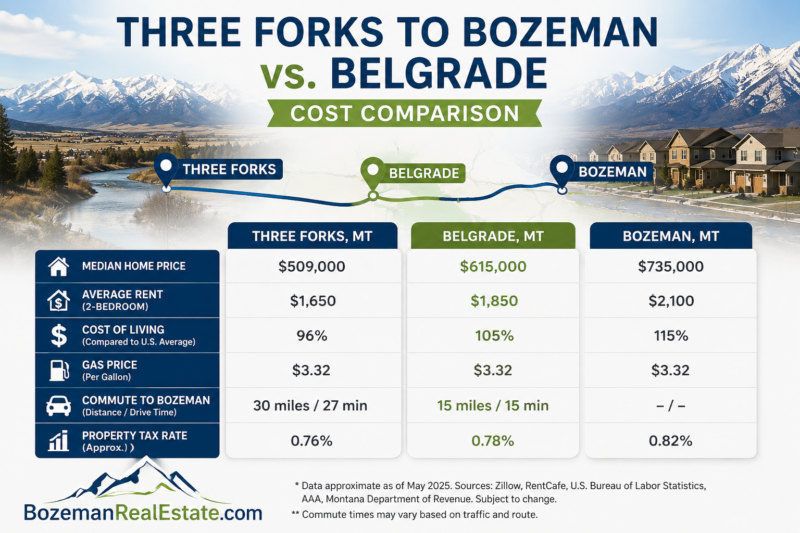
For a deeper look at how Belgrade stacks up specifically, see our breakdown of whether Belgrade is cheaper than Bozeman or our full Belgrade Montana vs. Bozeman comparison guide, or explore living in Manhattan, MT as a third alternative within the valley. Buyers casting a wider net across the Gallatin Valley can browse every option on our Communities page, including Paradise Valley for those drawn to riverfront acreage further from town.
What You’re Paying For: The Three Forks Lifestyle
The cost premium in Three Forks buys access to a genuinely unique piece of Montana. This is the town nearest the headwaters of the Missouri River, where the Jefferson, Madison, and Gallatin Rivers converge at Missouri Headwaters State Park — the same spot Lewis and Clark’s Corps of Discovery camped in 1805. World-class fly fishing on the Madison and Jefferson Rivers is minutes from downtown, and Madison Buffalo Jump State Park adds another layer of history and outdoor access nearby.

For residents who fish, hunt, hike, or simply want more land and quiet than Bozeman can offer, that access is a meaningful part of the value equation — one that doesn’t show up in a raw cost-of-living index. To see more of what draws people to the area beyond the numbers, our Ultimate Three Forks Montana Travel Guide covers dining, attractions, and family-friendly adventures around town.

Frequently Asked Questions
Is Three Forks, Montana affordable?
Three Forks is more affordable than Bozeman, but its overall cost of living still sits above the national average, mainly because of housing. Utilities, healthcare, and groceries are closer to national norms.
Is Three Forks cheaper than Bozeman?
Yes. Home prices and overall cost of living in Three Forks run below Bozeman’s, which is Montana’s most expensive real estate market. Buyers priced out of Bozeman commonly look at Three Forks for more land and lower entry prices.
What is the commute like from Three Forks to Bozeman?
Three Forks sits directly on I-90, and the drive to Bozeman typically takes around 30 minutes depending on traffic and season.
Does Montana have sales tax?
No. Montana has no state or local sales tax, which applies in Three Forks and statewide — a meaningful savings that helps offset higher housing costs.
What drives up the cost of living in Three Forks?
Housing is by far the largest factor. Grocery prices run modestly above average as well, while utilities and healthcare are close to or below the national average.
Thinking about a move to Three Forks, Montana? Jean White and Britney White of Berkshire Hathaway HomeServices Montana Properties specialize in Three Forks and greater Gallatin Valley real estate. Browse current Three Forks, MT homes for sale, learn more about the Three Forks community, or get local business and event information from the Bozeman Chamber of Commerce.

Leave a Reply