
West Yellowstone Cabins & Log Homes for Sale: Buyer’s Guide
By Jean White & Britney White, REALTORS® | Berkshire Hathaway HomeServices Montana Properties | BozemanRealEstate.com
Get West Yellowstone Market Reports, Free Every Month
Track home prices, new listings, and inventory trends in West Yellowstone — delivered straight to your inbox. No spam, just the numbers you need before you buy or sell.
Sign Up for Free West Yellowstone Market Reports →
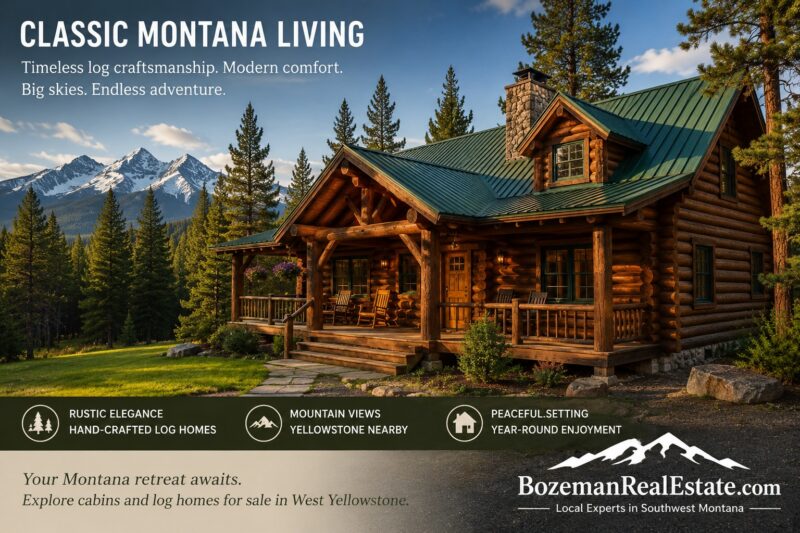
West Yellowstone cabins for sale cover more ground than most buyers expect — from tidy log-sided houses in the Madison Addition a few blocks from the park gate, to full timber log homes on Hebgen Lake, to century-old fishing cabins tucked along the Madison and Gallatin Rivers. If a log or timber cabin near the West Entrance to Yellowstone National Park is on your list, this guide walks through what’s actually for sale, what it costs, how financing a log home differs from a standard mortgage, and what to check before you write an offer.
View All West Yellowstone Listings
Why Buyers Want a Cabin Near West Yellowstone
West Yellowstone sits at 6,660 feet, boxed in on every side by National Forest and Yellowstone National Park land. That geography is exactly why log cabins and log homes are such a natural fit here — building materials and architectural style have leaned rustic and log-based since the town’s earliest cabin camps served park visitors arriving by rail. Today, buyers want the same thing for different reasons: a personal getaway steps from the park entrance, a fly-fishing or hunting base camp, or a short-term rental property that can carry itself through two distinct tourist seasons. For the broader picture on the town’s housing market, cost of living, and neighborhoods, our West Yellowstone real estate living guide is a good companion read to this one.
What Kind of Cabins & Log Homes Are Actually for Sale
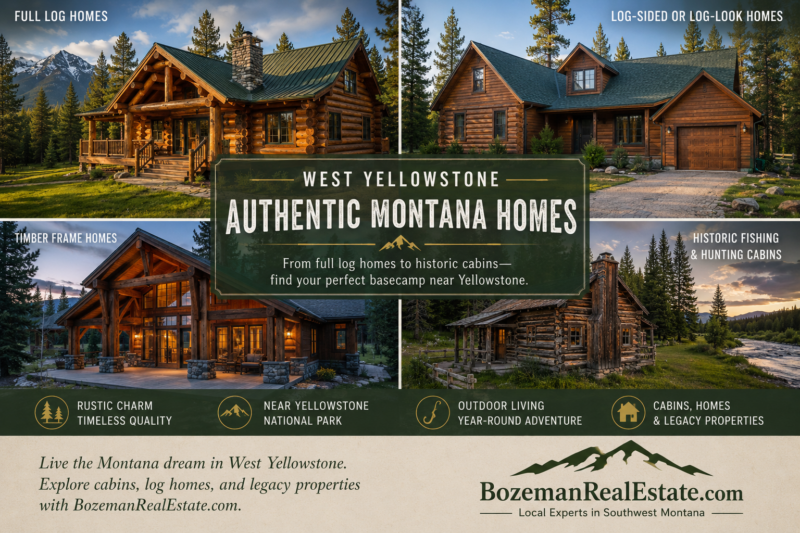
Not every “cabin” here is built the same way, and the construction type changes both the price and the financing conversation:
- Full-log (solid log) homes — stacked log walls, often handcrafted or milled log packages. These carry the strongest “authentic Montana cabin” character and the highest maintenance requirements.
- Log-sided or log-look homes — conventional stick-frame construction with log siding or log veneer. More common in the Madison Addition, easier to insure and finance, and often more energy-efficient.
- Timber-frame homes — heavy timber post-and-beam structure, usually paired with conventional insulated walls. A popular middle ground for buyers who want exposed wood character without full-log upkeep.
- Historic fishing and hunting cabins — older log structures on acreage near the Madison River, Hebgen Lake, or the South Fork, sometimes with multiple cabins on one parcel. These trade modern finishes for privacy, water access, and character.
West Yellowstone Cabin Market Snapshot (2026)
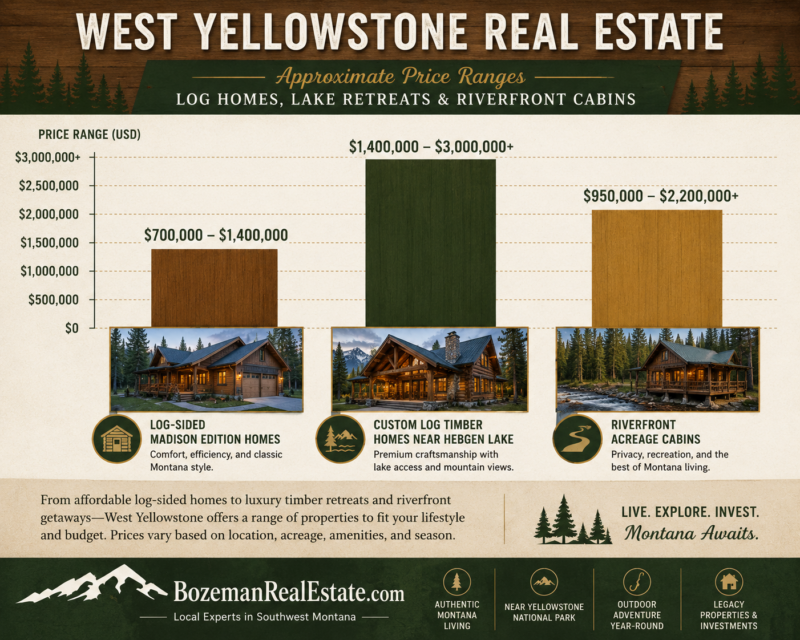
West Yellowstone’s overall housing market ran a median list price of roughly $1.09 million in mid-2026, at about $342 per square foot, with homes typically spending well over 100 days on market. Cabins and log homes track close to that town-wide figure, though pricing spreads wide depending on construction type, lot size, and proximity to water or the park gate:
- In-town log-sided homes (Madison Addition): typically the most affordable entry point, often priced in line with or slightly above the town median for comparable square footage.
- Custom full-log or timber-frame homes (Hebgen Lake Estates and surrounding acreage): command a premium for lake proximity, larger lots, and higher-end log or timber construction.
- Riverfront and acreage cabin properties: priced more on land, water frontage, and improvements than on square footage alone — multi-cabin fishing camps on 15+ acres can list well into seven figures.
Where to Find Cabins & Log Homes
Madison Addition — West Yellowstone’s primary in-town residential neighborhood, north of D Parkway. This is where you’ll find the highest concentration of log-sided and log-look homes on city water and sewer, walkable to downtown and the park entrance. It’s the practical choice for buyers who want cabin character without acreage upkeep.
Hebgen Lake Estates — a short drive north of town, with larger lots and direct proximity to Hebgen Lake’s fishing and boating. This is where you’ll find the area’s more substantial full-log and timber-frame custom builds, many designed from the start for dual use as a personal retreat and a short-term rental.
Outlying river and forest acreage — properties along the Madison River, South Fork, and Gallatin Canyon corridor toward Big Sky occasionally bring historic multi-cabin fishing camps to market — the kind of listing built in the early 1900s, since renovated, sitting on conservation-adjacent acreage with private pond or river frontage. These are rarer finds and worth watching for if character and privacy matter more than walkability.
If you’re cross-shopping log and mountain properties elsewhere in the region, our Ski-In/Ski-Out Properties in Big Sky guide and Madison River real estate guide cover comparable log and timber inventory closer to Big Sky and Ennis.
Financing a Log or Timber Home: What’s Different
Log and timber-frame homes are financeable — but the process isn’t identical to a standard mortgage on a conventional stick-built house, and it’s worth understanding before you fall for a listing photo:
- Appraisals lean on comparable sales, and log homes are inherently scarce, so appraisers often have to widen their search radius or use non-log rustic comps, which can affect the appraised value.
- Larger down payments are common. Lenders frequently ask for 20% down on log home purchases, particularly if the appraisal comes in conservative relative to the purchase price.
- New-build log packages typically require two loans — a construction loan to fund the build, followed by a standard long-term mortgage once the home is complete.
- Not every lender is “log-friendly.” Working with a loan officer who has closed log home deals before — and understands staggered log-package payment schedules — saves real time and stress.
- Acreage can add another layer. Riverfront or forest-adjacent parcels sometimes fall outside conventional secondary-market lending limits, which is where rural-focused or portfolio lenders come in.
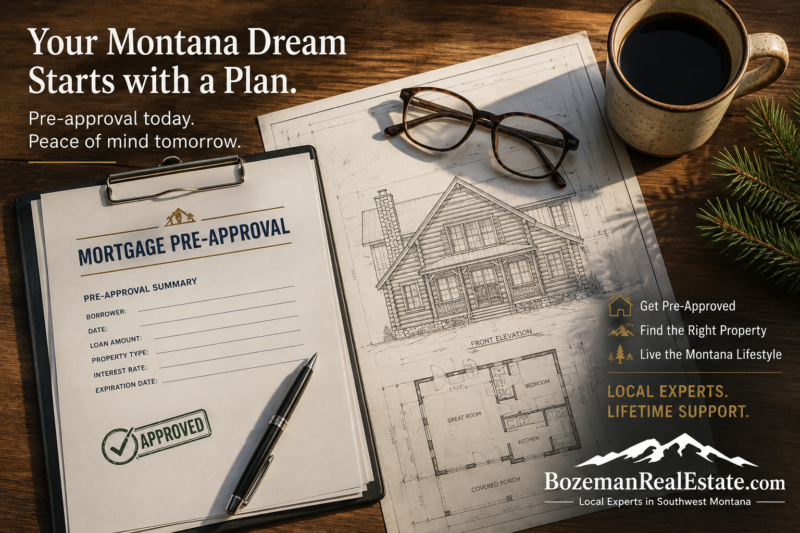
None of this should scare off a serious buyer — it just means getting pre-qualified with a lender experienced in unique or rural properties before you start touring, not after you’ve found the one.
What to Inspect Before You Buy a Log Cabin
A log or timber home carries a few inspection priorities a conventional house doesn’t:
- Chinking and log seams — check for gaps, cracking, or water staining between logs, which signal moisture intrusion risk.
- Log condition and rot — look closely at the base of exterior logs nearest grade, roof lines, and any spot where snow piles against the structure through winter.
- Roof and gutter design — wide eave overhangs matter more here than almost anywhere in Montana, given West Yellowstone’s snow load.
- Foundation and settling — full-log homes settle over years as logs dry and compress; a specialist inspector familiar with log construction should confirm the home has settled properly.
- Pest history — carpenter ants and wood-boring insects are a real consideration in log structures; ask for treatment and maintenance records.
- Winterization systems — heat tape, pipe insulation, and a documented snow-removal plan are not optional at this elevation.
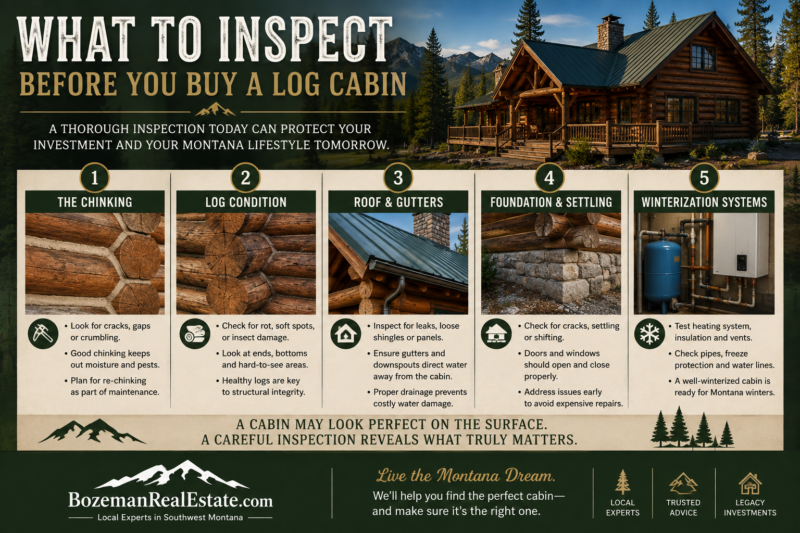
A standard home inspector can miss log-specific issues, so ask directly whether they have log home experience — or hire a specialist inspector for that portion of the report.
Cabin Maintenance & Ongoing Costs
Owning a log cabin here comes with a maintenance rhythm that differs from a conventional home:
- Re-staining and sealing every 3–5 years (sooner on south- and west-facing walls with more sun exposure) to protect the wood from UV and moisture.
- Re-chinking as needed where seams have opened or cracked — a periodic job, not a one-time fix.
- Annual winterization — heat tape checks, pipe insulation, and snow-load monitoring on roofs, particularly for steeper cabin rooflines.
- Pest inspection and treatment, typically annual, especially for full-log structures.
- Snow removal contracts, which most owners budget as a fixed winter line item rather than a one-off expense.
Buyers using a cabin as a short-term rental should build these costs into their income projections rather than treating them as occasional maintenance — they’re recurring, and they protect the asset’s long-term value.
Short-Term Rental Potential for West Yellowstone Cabins
Log cabins are some of the strongest-performing listing types in West Yellowstone’s vacation rental market — the aesthetic itself is a booking draw. The market here follows a two-peak seasonal pattern: a strong summer season tied to park visitors, and a second, sharper peak during winter weeks tied to snowmobile and snow coach access, with spring and late fall as the quieter shoulder months. Before buying with rental income in mind, confirm current short-term rental permitting, occupancy limits, and zoning requirements with the Town of West Yellowstone and Gallatin County, and make sure your insurance reflects commercial rental use rather than a standard homeowner policy. For a deeper look at the numbers behind rental strategy, our long-term vs. short-term rental investment guide breaks down the trade-offs in more detail, and the full West Yellowstone living guide covers current market snapshot data and neighborhood specifics.
Buying Process Tips for West Yellowstone Cabins
- Get pre-qualified with a log-experienced lender first. This alone can eliminate weeks of delay once you’re under contract.
- Tour in winter if you can, or ask detailed questions about winter performance — heating costs, road access, and snow load behave very differently than a summer walkthrough suggests.
- Budget the full ownership picture, not just the purchase price — staining, chinking, pest treatment, and snow removal are recurring costs specific to log construction.
- Hire an inspector with log home experience, or add a specialist inspection for the log structure specifically.
- Verify short-term rental zoning and permitting before you write an offer if rental income is part of your plan.
- Work with an agent who knows the difference between full-log, log-sided, and timber-frame construction — it changes financing, insurance, and long-term maintenance conversations significantly.
Frequently Asked Questions
How much do log cabins cost in West Yellowstone, MT?
Prices vary widely by construction type and location. In-town log-sided homes in the Madison Addition tend to track closest to West Yellowstone’s town-wide median (around $1.09 million as of mid-2026), while custom full-log or timber-frame homes near Hebgen Lake, and riverfront acreage cabin properties, often price higher based on lot size, water frontage, and finish level.
Is it harder to get a mortgage for a log home?
It can be more involved than a conventional mortgage. Appraisers rely on comparable sales, which are scarcer for log homes, and lenders often ask for a larger down payment — commonly 20% — as a result. Working with a lender who has closed log home loans before makes the process smoother.
What’s the difference between a full-log home and a log-sided home?
A full-log home has solid stacked-log exterior walls and requires more specialized maintenance, like chinking and re-staining. A log-sided home is conventional stick-frame construction finished with log siding or veneer — it delivers similar rustic style with easier maintenance, insurance, and financing.
Are West Yellowstone cabins good short-term rental investments?
Many are. Log cabins tend to perform well as vacation rentals thanks to their aesthetic appeal, and West Yellowstone’s two-peak seasonal demand (summer park visitors and winter snowmobile access) supports strong occupancy for well-positioned properties. Confirm local permitting and zoning before buying with rental income in mind.
What should I inspect before buying a log cabin?
Prioritize chinking and log seams, signs of rot or moisture near grade, roof and eave design relative to snow load, foundation settling, and pest history. A specialist inspector with log home experience can catch issues a general home inspector might miss.
Where are most log cabins located in West Yellowstone?
The Madison Addition has the highest concentration of in-town log-sided homes, while Hebgen Lake Estates and the surrounding forest and river corridors are where you’ll find larger custom full-log and timber-frame properties, plus occasional historic multi-cabin fishing camps on acreage.
Ready to Find Your West Yellowstone Cabin?
Whether you’re picturing a low-maintenance log-sided retreat in the Madison Addition or a full-log custom home on Hebgen Lake, Jean and Britney White have 37+ years of combined experience helping buyers navigate Gallatin Valley and gateway-community real estate — including the specific financing and inspection considerations that come with log and timber construction. Browse current West Yellowstone listings or get in touch to start your search today.
Stay ahead of the market: Sign up for free monthly Bozeman market reports, read our full West Yellowstone living guide for neighborhood and cost-of-living detail, or connect with the West Yellowstone Chamber of Commerce for local visitor and community resources.

Leave a Reply