
Big Sky vs. Bozeman: Cost of Living & Real Estate Comparison
By Jean White & Britney White, REALTORS® | Berkshire Hathaway HomeServices Montana Properties | BozemanRealEstate.com
Get Bozeman & Big Sky Market Reports, Free Every Month
Track home prices, new listings, and inventory trends in Bozeman and the greater Gallatin Valley — delivered straight to your inbox. No spam, just the numbers you need before you buy or sell. Sign Up for Bozeman Market Reports →
If you’re weighing Big Sky vs. Bozeman cost of living & real estate comparison, you’ve probably already noticed the two Gallatin Valley communities don’t compare like most side-by-side city matchups. They sit less than an hour apart on US-191, share the same mountain views, the same MLS system, and even the same ZIP code in places — yet one is Montana’s fastest-growing university city, and the other is a globally known ski resort where a single-family home can trade for eight figures. Understanding the real differences in home prices, everyday expenses, and lifestyle is essential before you decide where to plant roots in Southwest Montana. Sign Up for Big Sky Market Reports →
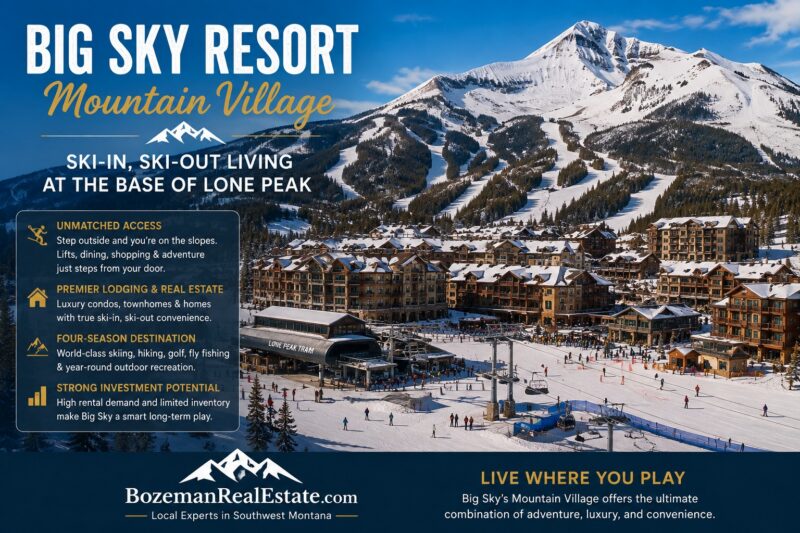
Big Sky vs. Bozeman Real Estate: The Headline Numbers
The single biggest difference between these two markets is price — and it isn’t close. Bozeman is Montana’s most expensive incorporated city, but Big Sky operates in an entirely different tier, driven by a resort economy of second-home buyers, ski-in/ski-out condos, and private club communities.
| Market Indicator | Bozeman, MT | Big Sky, MT |
|---|---|---|
| Median Home Price (2026) | ~$665,000 | ~$1.78M (typical home value) |
| Median List Price, Active Listings | ~$825,000 | ~$2.4M |
| Active Listings | 287+ | ~115 |
| Year-Round Population | 53,293 (2020 Census) | ~3,591 |
| Housing Vacancy Rate | Low — tight rental market | 64.9% (largely second homes) |
| Property Type Mix | Single-family, condo, townhome | Ski-in/ski-out condos, custom homes, private club estates |
Market statistics and data referenced in this article are sourced from realtor.com and Big Sky MLS. Figures are subject to change and should be independently verified for time-sensitive decisions.
Bozeman’s median sits around $665,000, with an average home value near $740,000 and 287-plus active listings giving buyers real room to negotiate in 2026. Big Sky’s housing market tells a completely different story: the Zillow Home Value Index puts the typical Big Sky home at roughly $1.78 million, while active listings carry a median list price closer to $2.4 million. Single-family homes in Big Sky have sold for as much as $5 million in recent quarters, and that’s before factoring in the ultra-private Yellowstone Club, whose sales aren’t publicly reported at all.
Why the gap? Nearly two-thirds of Big Sky’s housing units sit vacant most of the year — vacation homes for owners who live elsewhere. Bozeman, by contrast, is a full-time working city built around Montana State University, healthcare, tech, and tourism, with year-round demand driving a more “normal” (if still expensive) housing market.
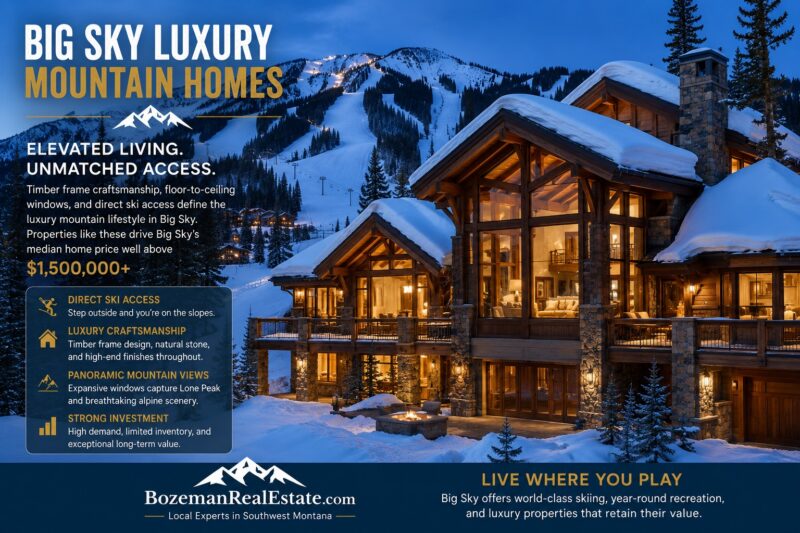
Cost of Living: A Surprising Twist
Big Sky vs. Bozeman: Cost of Living & Real Estate Comparison
Here’s where it gets interesting. Despite Big Sky’s dramatically higher home prices, general cost-of-living indices — which weigh groceries, utilities, healthcare, and transportation alongside housing — actually show Big Sky running slightly cheaper than Bozeman on day-to-day expenses. Comparison data from Best Places puts Bozeman’s overall cost of living roughly 8–9% higher than Big Sky’s, even though Big Sky’s home values are more than double Bozeman’s. Meanwhile, Big Sky’s 2026 cost-of-living index sits about 2% above the national average, driven primarily by housing, transportation, and food costs rather than by everyday essentials.
The explanation is that Big Sky’s real estate market is skewed by luxury second-home and resort transactions, while its renter and grocery-cost baselines (used in most COL calculators) land closer to the national average. Bozeman, as a full-scale city, has broader retail competition — but also higher sustained demand across every price tier, which pushes its everyday cost basket up.
| Category | Bozeman | Big Sky |
|---|---|---|
| Housing (purchase) | Moderate-high ($665K median) | Very high ($1.78M+ typical) |
| Rent | Tight market, elevated rates | Extremely limited supply; workforce housing shortage |
| Groceries | Slightly above national average | Slightly below national average (per COL index) |
| State Sales Tax | None (statewide) | None (statewide) |
| Property Tax Rate | ~0.84% effective rate | ~0.84% effective rate (same county mill structure) |
| Commute Costs | Low — most jobs are local | High — most service workers commute in from Bozeman |
Both towns benefit from Montana’s biggest structural advantage: no state sales tax, and property tax rates that run lower than most Western states. For buyers coming from California, Washington, or the Northeast, that alone can offset a meaningful chunk of the sticker-price difference.
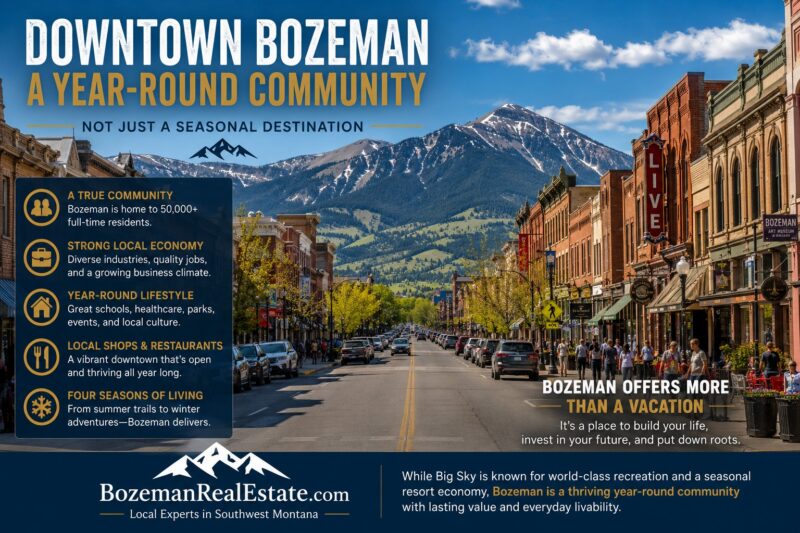
Jobs, Commuting & the Workforce Housing Gap
This is the piece most out-of-state buyers underestimate. Big Sky doesn’t have enough workforce housing for the people who staff its restaurants, ski patrol, hotels, and shops — so the majority commute from Bozeman, Belgrade, or communities along Gallatin Gateway, which sits roughly midway between the two. Local cost-of-living research estimates the added travel and opportunity cost for a Bozeman-based worker switching to a Big Sky job at around $5,460 per year, factoring in drive time and fuel.
That commute — about 45 miles and 45 to 50 minutes each way via the scenic but winter-prone Gallatin Canyon on US-191 — is the trade-off buyers need to weigh honestly. Bozeman residents get walkable amenities, MSU’s economic engine, Bozeman Yellowstone International Airport, and a diversified job market. Big Sky residents (and part-time owners) get direct mountain access, world-class skiing at Big Sky Resort, and a smaller, tourism-driven community — but far fewer daily conveniences and a genuine shortage of attainable local housing.
For buyers who want both — Big Sky’s proximity without paying full resort pricing — communities along the Gallatin Canyon corridor and Gallatin Gateway offer a middle path, roughly 35–40 minutes from Big Sky Resort at a meaningfully lower price per square foot than Big Sky proper.
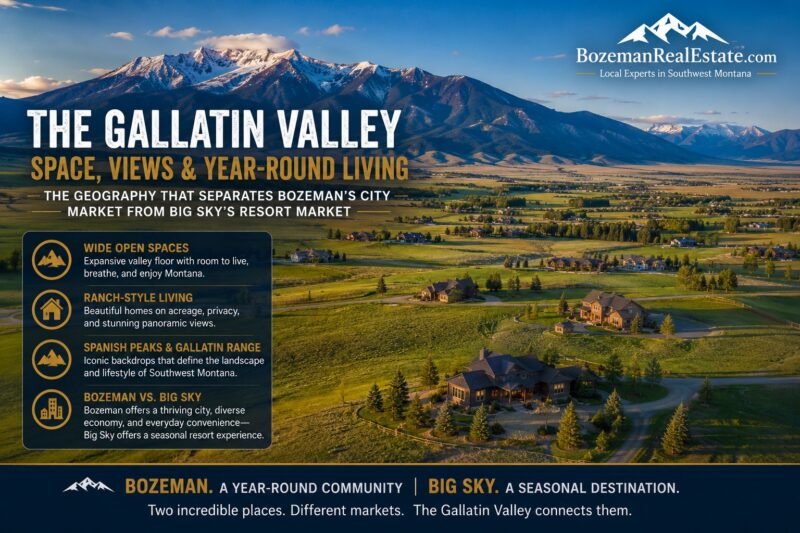
Lifestyle: Full-Time City vs. Resort Town
Bozeman functions like a real city — Montana’s fourth largest, with a full economy built on more than tourism. You’ll find year-round restaurants, a hospital system (Bozeman Health Regional Medical Center), breweries, a farmers market, MSU’s cultural calendar, and neighborhoods for every stage of life, from downtown lofts to family homes in Southeast Bozeman near Hyalite Canyon.
Big Sky, by contrast, is built almost entirely around recreation. Life there revolves around ski season, summer trail access, and the rhythms of a resort calendar — quieter in the shoulder seasons, packed during peak winter and summer weeks. It’s an outstanding lifestyle for buyers who want mountain access as their daily reality rather than a weekend drive, but it comes with a smaller year-round social fabric and less redundancy in services — one grocery store instead of five, one clinic instead of a hospital system.
Both markets share the same natural playground. Bozeman residents drive about 45 minutes south to ski at Big Sky Resort, while Big Sky residents make the reverse trip into Bozeman for big-box shopping, specialist medical care, and the airport. Neither town is fully self-contained — but Bozeman comes far closer.
Which Market Is Right for You?
- Choose Bozeman if you want a full-time job market, walkable downtown, year-round healthcare and retail, and a real estate market with more inventory and negotiating room in 2026.
- Choose Big Sky if your priority is direct mountain access, a second-home or investment property, and you can absorb both the price premium and the lifestyle trade-offs of a small resort community.
- Consider the Gallatin Canyon corridor or Gallatin Gateway if you want a shorter drive to Big Sky Resort without paying Big Sky’s per-square-foot premium.
Whichever direction you lean, both markets reward buyers who work with an agent who tracks both sides of the canyon — pricing, inventory, and negotiating leverage look nothing alike in Bozeman versus Big Sky, and a strategy built for one rarely transfers cleanly to the other.
Frequently Asked Questions
Is it cheaper to live in Big Sky or Bozeman?
On everyday cost-of-living indices — groceries, utilities, general expenses — Big Sky runs slightly cheaper than Bozeman, roughly 8% lower according to Best Places comparison data. However, Big Sky’s real estate purchase prices are dramatically higher, with a typical home value near $1.78 million compared to Bozeman’s roughly $665,000 median.
What is the median home price in Big Sky, Montana in 2026?
Big Sky’s typical home value sits around $1.78 million (Zillow Home Value Index), with active listings carrying a median list price closer to $2.4 million. Combined home, condo, and townhome sale prices have ranged from roughly $2 million to over $2.6 million in recent quarters.
What is the median home price in Bozeman, Montana in 2026?
Bozeman’s median home price is approximately $665,000 in 2026, with an average home value around $740,000. The market has stabilized after the 2020–2022 boom, with 287-plus active listings giving buyers more negotiating room than in previous years.
How far is Big Sky from Bozeman?
Big Sky is approximately 45 miles south of Bozeman via US-191 through the Gallatin Canyon, roughly a 45- to 50-minute drive depending on winter road conditions.
Does Montana have state sales tax?
No. Montana has no state sales tax, and this applies statewide in both Bozeman and Big Sky — one of the state’s biggest structural cost-of-living advantages, especially for buyers relocating from higher-tax states.
Why is there a workforce housing shortage in Big Sky?
Nearly two-thirds of Big Sky’s housing units are vacation homes that sit vacant most of the year, leaving very little inventory priced for local workers. As a result, most people employed in Big Sky commute from Bozeman, Belgrade, or the Gallatin Canyon corridor rather than living locally.
Can I ski at Big Sky Resort if I live in Bozeman?
Yes. Big Sky Resort is about a 45-minute drive from Bozeman, and many Bozeman residents ski there regularly while also having access to Bridger Bowl, just 16 miles from downtown Bozeman.
Related Reading
- Big Sky MT Real Estate: Luxury Homes, Condos & Ski Properties
- Bozeman Real Estate Market Update — Buying a Home in Bozeman MT in 2026
- Gallatin Gateway MT Real Estate: Homes, Land & Ranches (2026)
- Bozeman Montana Attractions & Best Neighborhoods (2026 Guide)
- Living in Paradise Valley Montana
Stay Ahead of the Bozeman Market → Sign Up For Big Sky Real Estate Market Updates
For local business resources and community information, the Big Sky Chamber of Commerce is a great starting point for entrepreneurs and companies considering the area.
Ready to buy or sell in Big Sky? Jean and Britney White bring 37+ years of combined Gallatin Valley experience — including deep familiarity with Big Sky’s private club and resort market — to every transaction. Call (406) 539-3914 (Jean) or (406) 539-2432 (Britney), or reach out through our contact page to talk through your Big Sky real estate goals.

Leave a Reply