
Buying a Home Outside Bozeman City Limits: Wells, Septic, Road Access & Hidden Costs
By Jean White & Britney White, REALTORS® | Berkshire Hathaway HomeServices Montana Properties | BozemanRealEstate.com
Buying a home outside Bozeman city limits is the dream for many Gallatin Valley buyers: more elbow room, mountain views from every window, space for horses or a shop, and a slower pace just minutes from town. But once you leave the city grid, the house comes with its own infrastructure. Instead of city water, sewer, and a plowed street, you may be responsible for a private well, a septic system, and a shared gravel road. This guide walks through what to inspect, what to ask, and what to budget before you write an offer on rural property near Bozeman, MT.
Get Bozeman Market Reports, Free Every Month
Track home prices, new listings, and inventory trends in Bozeman and the Gallatin Valley — delivered straight to your inbox. No spam, just the numbers you need before you buy or sell.
Sign Up for Free Bozeman Market Reports →
Why Buyers Look Outside Bozeman City Limits
Price per square foot and lot size are the two big draws. Inside town, most lots are measured in fractions of an acre; a few miles out, one to twenty acres is common. If you’re weighing raw land against an existing home, our guides on how much land costs in Bozeman, MT and building vs. buying in Bozeman are a good starting point. Buyers who want animals should also read our Bozeman horse properties guide.
The trade-off is that a rural home is really three purchases in one: the house, its water supply, and its wastewater system — plus the road that gets you there. Each one needs its own due diligence.

Wells: Water Rights, Well Logs & Testing When Buying Outside Bozeman City Limits
Montana’s exempt well rule
Most rural homes near Bozeman get domestic water from a private well. Under Montana law, a person doesn’t need a permit to develop a groundwater well with a use of 35 gallons per minute or less, not to exceed 10 acre-feet per year. That’s the “exempt well” most homes rely on — but exempt doesn’t mean unregistered.
Two recent changes matter for buyers and builders. First, starting January 1, 2026, appropriators must notify the DNRC of their intent to use groundwater under the exception by submitting a Notice of Intent (Form 602I) before putting the water to use. Second, within 60 days after the well is put to use, the owner must submit a Notice of Completion of Groundwater Development (Form 602) with a filing fee — and the filing fee for Form 602 is $250. Montana courts have also tightened how exempt wells work in multi-phase subdivisions: a 2024 district court ruling found DNRC incorrectly let a developer appropriate up to 10 acre-feet for each phase of a four-phase subdivision. If you’re buying a lot in a newer subdivision, ask how water was permitted. The Montana DNRC’s permit exceptions page is the authoritative source. Exceptions To Permit Requirements +3
When you buy an existing home, the water right needs to be transferred into your name. Your title company and agent should confirm a water right number exists and that the ownership update is filed after closing. We cover the same topic for river properties in our Paradise Valley Montana water rights buyer’s guide.
Pull the well log
Every well drilled by a licensed driller should have a well log. The driller completes a Well Log Report and sends it to the Montana Bureau of Mines and Geology within 60 days, and a copy goes to the well owner. These logs live in the Ground Water Information Center (GWIC) database, where a well log shows depth, water level, and the geologic material around the well. Ask the seller for it, or look it up yourself. Key items to review: total depth, static water level, and the tested yield in gallons per minute. Neighbors’ logs on GWIC also tell you how deep wells typically go in that section — useful if you’re buying land and need to drill.
Test the water and the flow
Make your offer contingent on a water-quality test (at minimum bacteria and nitrates; many buyers add arsenic, uranium, and hardness) and a flow/yield test. A slow well may still be “fine” for a couple but frustrating for a family with irrigation needs.
What a new well costs
If you’re buying raw land, budget for drilling. One 2026 cost guide estimates Gallatin Valley wells at roughly 150–350 feet deep and about $12,000–$22,000 installed, with foothill and bedrock sites running higher. Get a per-foot rate and a not-to-exceed figure in writing.

Septic Systems in Gallatin County: Permits, Records & Inspections
Know the permit rules
Outside city sewer service, nearly every home runs on an on-site wastewater (septic) system regulated by the Gallatin City-County Health Department. A local wastewater permit is always required before any system is installed, site evaluations must be done by a Gallatin County Registered Site Evaluator or a Montana-registered Professional Engineer, and a registered installer must be on site during every installation. Sizing and placement are based on either a Certificate of Subdivision Approval (COSA) or a site evaluation that assesses whether the site can handle on-site treatment.
Timing matters if you plan to add a bedroom, build a guest house, or replace a failing system after closing. According to the Gallatin City-County Health Department’s septic page, staffing shortages and high permit volume have pushed wastewater review times to around 40 days.
Check the records
Ask for the septic permit and as-built drawing, then confirm them against county records. The number of bedrooms the system was permitted for should match the house you’re buying. A five-bedroom home on a three-bedroom permit is a red flag for future expansion, refinancing, or resale.
Inspect and pump
A professional septic inspection — including pumping the tank, checking baffles, and evaluating the drain field — is one of the best few-hundred-dollar investments in a rural purchase. Replacing a failed drain field can easily run into five figures, and some sites, such as those in impaired watersheds, may require more advanced treatment than a conventional tank and drain field.

Road Access Outside Bozeman: County, Subdivision & Private Roads
Who plows your road?
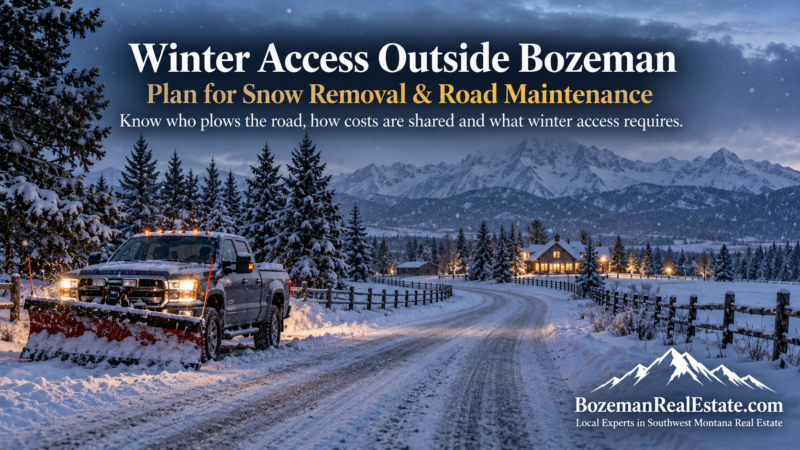
This is the question rural buyers forget to ask until the first January storm. Gallatin County’s Road Department maintains county roads, but its work does not include subdivision roads (public roads maintained by residents, usually through an HOA or RID) or private roads and bridges owned and maintained by residents. The county itself advises buyers to investigate road conditions and maintenance before purchasing, and you can call the Road Department at 406-582-3250 to confirm whether a road is county-maintained.
Legal access vs. physical access
A driveway you can drive on isn’t the same as a recorded right to use it. Ask your title company to confirm a recorded easement from the public road all the way to your property line. Access disputes do happen here — in one Gallatin Gateway-area case, landowners sued after a road to their 800 acres was gated, arguing the land would be worth considerably less without a written easement.
Road maintenance agreements
If the road is shared, look for a recorded road maintenance agreement or association. It should spell out how plowing, grading, and gravel costs are split, and it should bind future owners. No agreement means neighbors negotiate every repair — often at the worst possible time. Buyers looking at acreage near Belgrade or the foothills around Springhill and Sypes Canyon run into this regularly.
The Hidden Costs of Buying a Home Outside Bozeman City Limits
Rural homes often pencil out lower per square foot, but the monthly and one-time costs look different from in-town living. Plan for these:
- Property taxes and road levies. You won’t pay city levies, but the county road department is funded partly by a mill levy on property owners outside city limits. Subdivision HOA or RID assessments for roads can stack on top.
- Snow removal. On a long private drive, you’ll either own a plow setup or pay a contractor.
- Heating fuel. Many rural homes run on propane rather than natural gas, so budget for tank rental and fills.
- Internet. Fiber and cable may stop well before your driveway. Confirm service at the exact address, not the zip code.
- Fire protection and insurance. Distance to the nearest fire station and hydrant affects homeowner’s insurance premiums. Get a quote during your inspection period.
- Water treatment. Softeners, UV systems, or filters for hard or mineral-heavy well water.
- Septic pumping and well-pump replacement. Routine maintenance plus the eventual pump or pressure tank swap.
- Commute and errands. Fuel and drive time add up, especially in winter.
Financing can also differ. Some lenders require a passing water test or septic inspection before closing, and acreage or outbuildings may affect appraisal. Our guides to Bozeman mortgage rates in 2026 and financing and down payment assistance programs help you plan ahead.
Market statistics and data referenced in this article are sourced from realtor.com and Big Sky MLS. Figures are subject to change and should be independently verified for time-sensitive decisions.

Where Buyers Find Homes Outside Bozeman City Limits
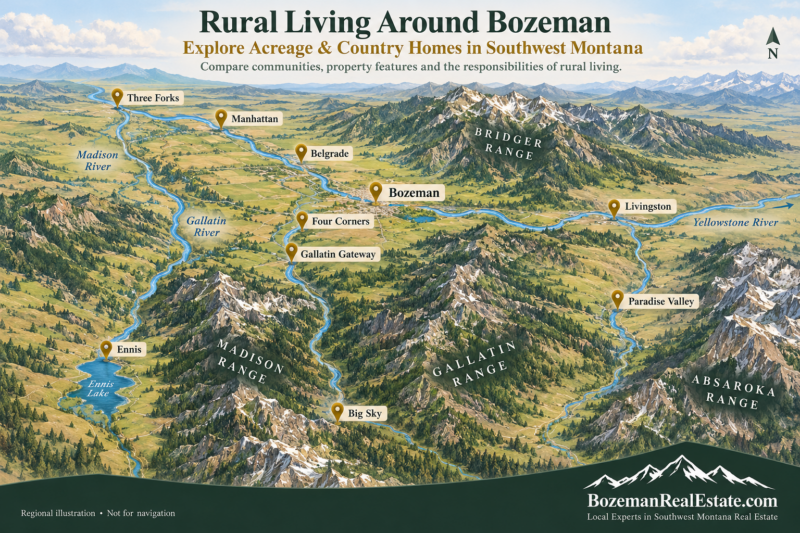
Rural and acreage homes are spread across Southwest Montana, and each area has its own water, road, and commute profile:
- Four Corners — close-in acreage between Bozeman, Big Sky, and Belgrade.
- Gallatin Gateway — canyon-mouth properties on the road to Big Sky.
- Belgrade — rural parcels north and west of town, plus land for sale near Springhill.
- Manhattan and Three Forks — farm and ranch ground in the west valley.
- Livingston, Paradise Valley, Emigrant, and Pray — river and foothill properties along the Yellowstone.
- Ennis and the Madison River corridor — anglers’ homes and ranchettes.
- Big Sky and West Yellowstone — mountain properties with their own winter-access realities.
For riverfront homes, see Montana riverfront property for sale. To compare everything at once, browse our Southwest Montana communities page or our Southwest Montana real estate guide.
Your Due Diligence Checklist for Buying a Home Outside Bozeman City Limits
Build these into your purchase contract and inspection period:
- Well log, water right number, and ownership transfer plan
- Water-quality and flow/yield tests
- Septic permit, as-built drawing, bedroom count match, and pumped inspection
- Title review confirming a recorded access easement to the property
- Road maintenance agreement or HOA/RID documents and dues
- Internet, propane, and electric provider confirmation at the address
- Homeowner’s insurance quote, including fire protection rating
- Survey or boundary verification for fences, outbuildings, and drain fields
If you’re early in the process, start with our Bozeman buyers page and see why buyers work with us.
Frequently Asked Questions About Buying a Home Outside Bozeman City Limits
Do I need a water right for a well on rural property near Bozeman?
Most domestic wells use Montana’s exempt well provision (35 gallons per minute or less, no more than 10 acre-feet per year), but they still need to be filed with the DNRC. Since January 1, 2026, a Notice of Intent (Form 602I) is required before using water under the exception, followed by a Form 602 after completion. On an existing home, make sure the water right transfers to you.
How do I find the well log for a home I’m buying?
Ask the seller first. Otherwise, search the Montana Bureau of Mines and Geology’s Ground Water Information Center (GWIC) database, which holds logs showing depth, water level, and yield.
How long does a septic permit take in Gallatin County?
The Gallatin City-County Health Department currently reports review times of around 40 days. Build that into any plan to add bedrooms, build a guest house, or replace a system.
Who maintains roads outside Bozeman city limits?
It depends on the road. Gallatin County maintains county roads, but not subdivision roads or private roads. Those are maintained by residents, often through an HOA, RID, or road maintenance agreement. Call the county Road Department to confirm.
Should I get a septic inspection even if the system seems fine?
Yes. A pumped inspection checks the tank, baffles, and drain field and verifies the permitted bedroom count. It’s inexpensive compared with replacing a failed drainfield.
Are property taxes lower outside Bozeman city limits?
You won’t pay city levies, but you will pay the county road mill levy that applies to properties outside city limits, plus any subdivision HOA or RID assessments.
Can I build a guest house or ADU on a rural property with septic?
Possibly, but the septic system must be sized for the added use, and that requires a permit from the health department. Confirm capacity before you buy if this matters to you.
Is buying acreage near Bozeman a good investment?
Land and acreage near Bozeman have historically been in strong demand, but value depends heavily on water, access, and septic suitability. A property with clean records on all three is far easier to resell.
Stay Ahead of the Bozeman Market
Bozeman’s inventory is tight and prices move fast when the right home hits the market. Sign up for free monthly Bozeman real estate reports and be the first to know about new listings, price shifts, and market trends before they hit the headlines.
Sign Up for Free Bozeman Market Reports →
Ready to Find Your Place Outside Bozeman?
Rural properties reward careful buyers. We help clients review well logs, septic records, easements, and road agreements before they commit, so the only surprise is how good the view is. Search Bozeman-area listings or contact Jean and Britney to start your search.
Bozeman Chamber → bozemanchamber.com
Stay Ahead of Bozeman Market → Bozeman Homes for Sale

Homes For Sale In Bozeman MT
Leave a Reply