
Paradise Valley Montana Zoning: What Buyers Need to Know Before Building
By Jean White & Britney White, REALTORS® | Berkshire Hathaway HomeServices Montana Properties | BozemanRealEstate.com
If you’re shopping for land or a home south of Livingston, Paradise Valley Montana zoning is one of the first things to understand. Not all of the valley is zoned, so the rules on one side of a county road can be very different from the rules a mile away. Parts of the valley require at least 20 acres for any new lot. Other areas cap building height, protect ridgeline views, or keep out large commercial projects. The rules were updated in late 2025, so this guide covers what has changed, where each set of rules applies, and what to check before you write an offer.
Get Paradise Valley Market Reports, Free Every Month
Track home prices, new listings, and inventory trends in Paradise Valley and the Livingston area, delivered straight to your inbox. No spam, just the numbers you need before you buy or sell.
Sign Up for Free Paradise Valley Market Reports →
Why Paradise Valley Montana Zoning Matters More Than Ever
Paradise Valley runs about 50 miles along the Yellowstone River, from Livingston south to Yankee Jim Canyon near Gardiner. The Absaroka Range sits on the east side and the Gallatin Range on the west. It’s some of the most sought-after ranch country in the West, and that demand has put pressure on the land. Over the past two years, a proposed 90-acre cabin resort, a proposed gravel pit, and a new luxury resort near Emigrant have all pushed residents and the county to look harder at how the valley grows.
Most of Park County outside Livingston has no zoning at all. In those areas, the county can review subdivisions, septic systems, and floodplain permits, but it has little say over what gets built on an existing parcel. That’s why landowners in several parts of the valley have used Montana’s citizen-initiated zoning law to set their own rules. As a buyer, knowing which category a parcel falls into tells you what you can build, what your neighbors can build, and what could happen to the view you’re paying for.
If you’re new to the area, start with our Living in Paradise Valley Montana community guide and our Moving to Paradise Valley, Montana relocation guide, then come back here for the land-use details.
The Seven Park County Zoning Districts
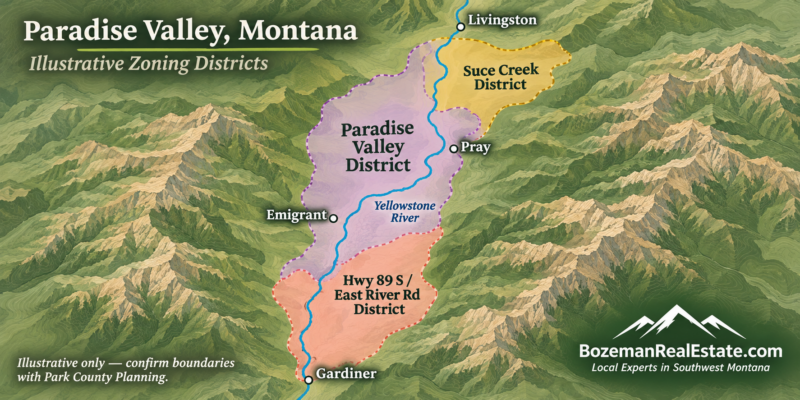
The Park County Planning Department’s zoning page lists seven zoning districts in the county: six started by citizens and one started by the county. They are:
- Paradise Valley District
- Suce Creek District
- US Hwy 89 S – East River Rd – Old Yellowstone Trail District
- East Yellowstone District
- O’Rea Creek District
- Cokedale District
- Cooke City – Silver Gate – Colter Pass District
The first three cover land in or next to Paradise Valley, and each has its own regulations. Two homes with the same Livingston mailing address can sit under completely different rules. The rest of the valley follows only the county’s general subdivision, septic, floodplain, and road standards.
The Paradise Valley Zoning District: The 20-Acre Rule
The best-known set of Paradise Valley Montana zoning rules comes from the Paradise Valley Zoning District. Park County’s Growth Policy says the district was created on June 1, 2004, centered on the area around Mill Creek Road and East River Road. From the start, it required new lots to be 20 acres or larger and restricted building on ridgetops.
What that means for you:
- You generally can’t split land into lots smaller than 20 acres inside the district. A 40-acre parcel may support two homesites. A 25-acre parcel usually supports one.
- Density is roughly one primary home per 20 acres. Before you buy, confirm how the current regulations treat guest cabins, caretaker quarters, and accessory buildings.
- Ridgetop and viewshed rules can limit where you place a home, not just whether you can build one.
The district’s own regulations are the final word on all of these, so ask for a copy and read it before you commit to a parcel. Our Paradise Valley Montana Homes with Acreage guide covers what acreage costs and where it tends to come up for sale.
What Changed in 2025: Height Limits and Viewshed Rules
Paradise Valley zoning got its biggest update in years in fall 2025.
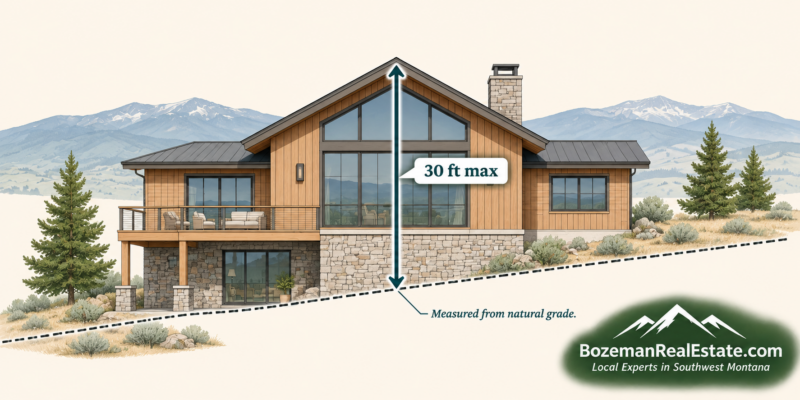
October 21, 2025. Park County commissioners approved an amendment to the district regulations. It set a 30-foot height limit, clarified that height is measured from natural grade, removed a viewshed test for Mill Creek Ridge, and kept the viewshed protections on the remaining Elbow Creek properties.
November 18, 2025. After hours of public testimony and a divided debate, the commission adopted an amended version of the regulations that further clarified how building height is measured. Opponents argued the late change limited property rights and raised legal concerns. Supporters saw it as needed clarity for builders and neighbors.
Why this matters for buyers:
- Walkout basements and sloped lots. Because height is measured from natural grade, a hillside lot can lose usable height on the downhill side. Have your architect check the plans against the measurement method before you finalize them.
- View-protected parcels. If you’re looking near Elbow Creek, viewshed rules may affect where on the lot you can build, how big the home can be, and possibly its color and materials.
- Mill Creek Ridge. Removing the viewshed test there gives owners more flexibility than before, though the 30-foot height limit still applies.
The Suce Creek District: Why It Was Created
Suce Creek is one of Paradise Valley’s northernmost drainages, just a few miles south of Livingston off Highway 540 (East River Road). In December 2024, Miami-based Flex Capital proposed a resort there on a 90-acre parcel, with more than 100 buildings and 400 parking spaces. At the time, the area had about a dozen homes, a cattle herd, and a trailhead into the Absaroka-Beartooth Wilderness.
Without zoning, the county had little authority to stop a commercial project of that size, so residents organized. Supporters collected signatures from about 85% of residents, well above the 60% that state law requires. On July 15, 2025, the Park County Commission voted unanimously to give preliminary approval to the Suce Creek Planning and Zoning District, and the county now lists it as an active district. The Montana Free Press coverage of the Suce Creek zoning effort explains the background in detail.
The district is meant to protect agriculture and rural home uses and to keep out large commercial and industrial projects that don’t fit. For a buyer, that cuts both ways:
- Good news: Your view and quiet are much less likely to be changed by a large resort or industrial project next door.
- Trade-off: If you were hoping to run a commercial venture, such as an event venue, a lodge, or a large rental operation, read the district’s allowed and conditional uses before you buy.
Un Zoned Paradise Valley: More Freedom, More Risk
Outside the zoning districts, most of Paradise Valley has no zoning. That attracts buyers who want room to build a shop, run livestock, or put up the home they want without design review. But it comes with real risk.
What still applies in un zoned areas:
- Subdivision review. Montana law treats creating any parcel smaller than 160 acres as a subdivision, which needs county approval, environmental review, and time.
- Septic permits. New or replacement septic systems need a permit from Park County Environmental Health, and soil, bedrock depth, and groundwater can limit both the design and the cost.
- Floodplain rules. Land near the Yellowstone River or its tributaries may fall in a mapped flood hazard area, which affects where you can build and what insurance costs.
- Water. A well log is not a water right. Our Paradise Valley Montana Water Rights Buyers Guide explains how to check irrigation and well rights before closing.
What doesn’t apply: In un zoned areas, the county generally can’t block a neighbor from putting a commercial or industrial use on their own land. That’s how the Suce Creek resort and the 2026 gravel pit proposals both reached the public-debate stage.
Countywide zoning has been hard to pass. In 2022, commissioners indefinitely postponed a proposed countywide agricultural and residential preservation district after pushback. In June 2024, voters rejected a referendum to repeal the county growth plan, and they also passed an initiative requiring voter approval for new or amended growth plans outside Livingston and Clyde Park. Under a 2021 state law (HB 527), residents who start a citizen-initiated district also have to pay for drafting its regulations. Because of all this, any new zoning is likely to come one drainage at a time, the way Suce Creek did.

If river frontage is on your list, our guide to living along the Yellowstone River in Paradise Valley covers what daily life is like on the water.
Conservation Easements: Protected Land, Permanent Limits
Conservation easements are another big factor in Paradise Valley land use. In April 2026, the Nickelson family placed a 437-acre property under a voluntary conservation easement with Northern Yellowstone Open Lands. It borders the recently conserved Warfield Ranch and connects to U.S. Forest Service land.
An easement is not zoning, but for a buyer it can matter even more:
- If the parcel you’re buying has an easement, the restrictions are permanent and recorded against the land. They often limit subdivision, the number of homes, and where buildings can go. Order a title report early and read the easement itself.
- If the land next door has an easement, your view and surroundings are protected for good, which many buyers will pay extra for.
How Paradise Valley Zoning Affects Home Values
Zoning and easements influence prices in Paradise Valley as much as acreage or river frontage does. A parcel that can legally be split into two homesites is worth more than the same acreage that can’t. A home whose view is protected by a neighboring easement or a viewshed rule usually holds its value better than one next to un zoned land that could be developed.
For current prices, inventory, and time-on-market trends, see our Paradise Valley MT Real Estate Market Report. If you’re also considering a home in town, Livingston vs. Paradise Valley Real Estate compares the two side by side.
Market statistics and data referenced in this article are sourced from realtor.com and Big Sky MLS. Figures are subject to change and should be independently verified for time-sensitive decisions.
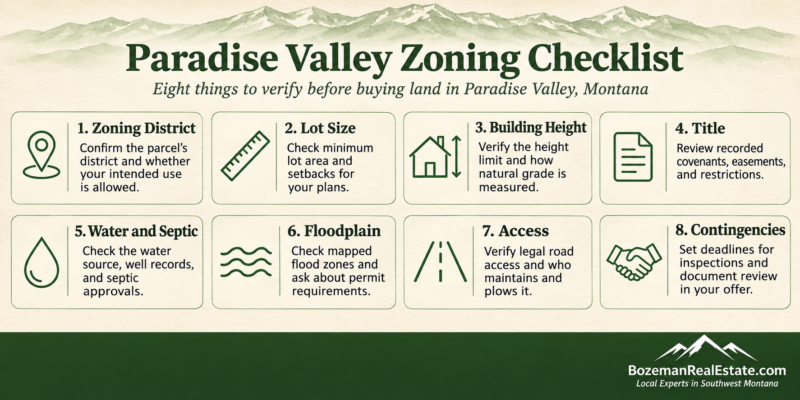
Paradise Valley Montana Zoning Checklist for Buyers
Before you make an offer on land or a rural home anywhere in the valley, go through this list.
- Confirm the zoning district. Ask Park County Planning whether the parcel is in the Paradise Valley, Suce Creek, or Hwy 89 S–East River Rd district, or is un zoned. Get the current regulations in writing.
- Check density and lot size. If you plan to split the land later or add a second home, confirm that the zoning and Montana subdivision law allow it.
- Check height and viewshed rules. Bring your preliminary plans or a builder’s sketch to the county and confirm the 30-foot limit and any viewshed requirements.
- Pull a title report. Look for conservation easements, covenants, access easements, and severed mineral rights.
- Verify water and septic. Get the well log, a water rights abstract, and a septic evaluation or soil test.
- Check the floodplain map. Especially on riverfront or creek side land.
- Confirm road access. Find out whether the road is county-maintained, private, or easement-only, and who plows it in winter.
- Write contingencies into your offer. Give yourself time to confirm zoning, septic, and water before your earnest money is at risk.
Where Paradise Valley Zoning Applies by Community
- Livingston outskirts and Suce Creek. Closest to town. Watch for Suce Creek district rules and the City of Livingston’s separate permits near town. See our Paradise Valley Estates neighborhood page and the wider Livingston neighborhoods index.
- Pine Creek, Mill Creek, and East River Road. The heart of the original Paradise Valley Zoning District. Expect the 20-acre minimum and height rules. See Living in Pray, MT.
- Emigrant and Chico. A mix of zoned and un zoned land near the Hwy 89 corridor. See Living in Emigrant, MT and our Chico Hot Springs & Paradise Valley guide.
- Gardiner and the south end. Separate rules apply near Yellowstone’s north entrance. See Living in Gardiner, MT.

How Jean & Britney White Help Paradise Valley Buyers
Zoning is where many rural deals go wrong: a lot that turns out not to be splittable, a building site that won’t pass the height rules, or an easement nobody read until closing. We help buyers check zoning, water, septic, and access before writing an offer, and we write contingencies that protect you if something doesn’t check out. Whether you want a riverfront cabin, a working ranch, or a homesite with Absaroka views, we’ll help you understand the rules before you commit.
Browse current Paradise Valley Montana homes for sale or reach out to start a land search.
Frequently Asked Questions About Paradise Valley Montana Zoning
Is all of Paradise Valley, Montana zoned?
No. Only certain areas fall within Park County zoning districts, including the Paradise Valley District, the Suce Creek District, and the US Hwy 89 S – East River Rd – Old Yellowstone Trail District. Much of the valley is un zoned and follows only the county’s general subdivision, septic, floodplain, and road standards.
What is the 20-acre rule in Paradise Valley?
Inside the Paradise Valley Zoning District, newly created lots generally must be 20 acres or larger, which works out to about one primary home per 20 acres. Confirm the current regulations with Park County Planning before you buy.
What is the building height limit in Paradise Valley?
A 2025 amendment to the Paradise Valley zoning district regulations set a 30-foot height limit, measured from natural grade. Hillside lots and walkout designs should be checked carefully against how the regulations measure height.
Why was the Suce Creek zoning district created?
Residents started the Suce Creek district after a Miami-based developer proposed a 90-acre resort with more than 100 buildings in the rural drainage. The district protects agriculture and rural home uses and keeps out large commercial and industrial projects.
Can I subdivide land in Paradise Valley?
Possibly, but it depends on the zoning and on Montana subdivision law. Inside the Paradise Valley Zoning District, new lots generally must be at least 20 acres. Anywhere in the county, creating a parcel smaller than 160 acres counts as a subdivision and needs county review.
Do I need a septic permit to build in Paradise Valley?
Yes. New or replacement septic systems need a permit from Park County Environmental Health, and soil conditions, bedrock depth, and groundwater can limit what you can install.
How do conservation easements affect buying land in Paradise Valley?
A conservation easement permanently limits how a property can be developed, often restricting subdivision and the number or location of buildings. Always read any recorded easement in the title report before you buy.
Where can I find the official Paradise Valley zoning regulations?
The Park County Planning Department posts the regulations for each zoning district on its website. You can also call or visit the planning office in Livingston to confirm which rules apply to a specific parcel.
Stay Ahead of the Paradise Valley Market
Paradise Valley’s inventory is tight and prices move fast when the right home hits the market. Sign up for free monthly Paradise Valley real estate reports and be the first to know about new listings, price shifts, and market trends before they hit the headlines.
Sign Up for Free Paradise Valley Market Reports →
Bozeman Chamber → bozemanchamber.com
Livingston Area Chamber → livingston-chamber.com
Stay Ahead of Paradise Valley Market → Paradise Valley Homes for Sale

Homes For Sale In Paradise Valley MT
Leave a Reply