
What Is It Like to Live Along the Yellowstone River in Paradise Valley, Montana?
By Jean White & Britney White, REALTORS® | Berkshire Hathaway HomeServices Montana Properties | BozemanRealEstate.com
Living along the Yellowstone River in Paradise Valley means waking up to the sound of moving water, watching elk cross the hay meadows at dusk, and having world-class trout water a few steps from your back door. It also means learning the river’s moods. Spring runoff, winter ice, and the occasional record flood are as much a part of riverfront life here as the views of Emigrant Peak. If you’re considering Yellowstone River property in Paradise Valley, this guide covers the daily reality: the good, the demanding, and what to check before you buy.
Get Paradise Valley Market Reports, Free Every Month
Track home prices, new listings, and inventory trends in Paradise Valley and along the Yellowstone River corridor, delivered straight to your inbox. No spam, just the numbers you need before you buy or sell.
Sign Up for Free Paradise Valley Market Reports →
Where the Yellowstone River Runs Through Paradise Valley
The Yellowstone leaves Yellowstone National Park at Gardiner and runs north roughly 50 miles through Paradise Valley to Livingston. The Absaroka Range rises to the east and the Gallatin Range to the west. It is the longest free-flowing river in the lower 48, with no mainstem dams. That single fact shapes almost everything about living beside it: high spring flows, clear late-summer water, and a river channel that still moves on its own terms.
Two roads frame the valley. US Highway 89 runs along the west side and carries most traffic between Livingston and Gardiner. East River Road follows the east bank past Pray and the Chico Hot Springs area, and many of the valley’s riverfront homes and ranches sit off it. Small unincorporated communities like Emigrant and Pray serve as the valley’s informal hubs. Livingston is the full-service town at the north end. For the full overview of the valley’s communities, start with our Living in Paradise Valley Montana guide.

A Day in the Life: Living Along the Yellowstone River
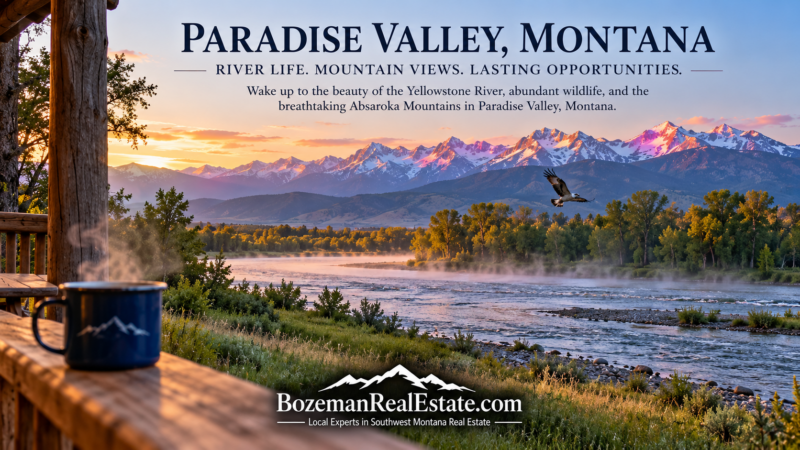
Ask longtime riverfront owners what they love most and you rarely hear “the house.” You hear about the river’s rhythm. Mornings often start with coffee on the deck while mist lifts off the water and an osprey works the riffle below. Bald eagles, great blue herons, mule deer, and whitetails are regular visitors. In winter, elk herds move down from the high country to feed on valley-floor meadows, often in plain view of riverfront homes.
The river sounds different every season. In June it’s a constant roar. By August it drops to a soft, clear murmur. In January, shelf ice creaks and groans along the banks. Many owners say that sound is the thing they miss most when they travel.
Daily errands take planning. Groceries, the hospital, and most services are in Livingston, 20 to 50 minutes away depending on where you sit in the valley. Bozeman and Bozeman Yellowstone International Airport are another 25 miles beyond that. Most residents batch their errands into one town trip a week. If you’re weighing town convenience against valley space, our Livingston vs. Paradise Valley real estate comparison walks through that trade-off in detail.
Fishing, Floating, and River Recreation at Your Doorstep
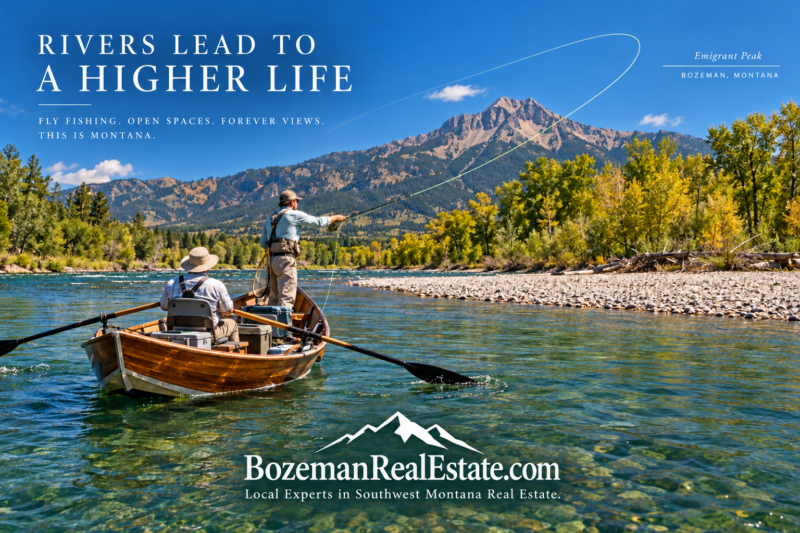
For many buyers, fishing is the reason to live on the Yellowstone. The stretch through Paradise Valley is classic blue-ribbon trout water, with cutthroat, rainbow, and brown trout. The Mother’s Day caddis hatch in early May is a local ritual. The valley’s private spring creeks, Armstrong, DePuy, and Nelson’s, draw anglers from around the world. Drift boats, rafts, and kayaks are common from late June through October. Plenty of riverfront owners keep a boat trailer by the garage and float a different section every weekend.
Public access matters here too. Montana Fish, Wildlife & Parks manages a string of fishing access sites through the valley, including Mallard’s Rest, Pine Creek, Emigrant, and Point of Rocks. The newest, Siskin Island, is reachable by boat between Mallard’s Rest and Pine Creek. For a deeper look at the valley’s recreation, including hiking in the Absaroka-Beartooth Wilderness and soaking at Chico, see our guides to fly fishing and outdoor recreation in Paradise Valley and Chico Hot Springs & Paradise Valley.
Montana’s Stream Access Law: What Riverfront Owners Should Know
One of the biggest adjustments for buyers from out of state is that owning riverfront land in Montana does not mean owning a private river. Under the Montana Stream Access Law, the public may use rivers and streams for recreation up to the ordinary high-water mark. The law does not allow anyone to cross private land to reach the water or to enter posted land along the banks. Public bridges and county road rights-of-way also provide legal access points.
In practice, anglers and floaters will pass your property, and they may legally stop on gravel bars below the high-water mark. Most owners come to see it as part of the Montana way of life. Many of them fish from a boat on someone else’s frontage the next day. If absolute privacy on the water is essential to you, it’s worth talking with us about properties set on side channels, spring creeks, or high benches above the main river.
Spring Runoff, Floods, and Floodplain Due Diligence
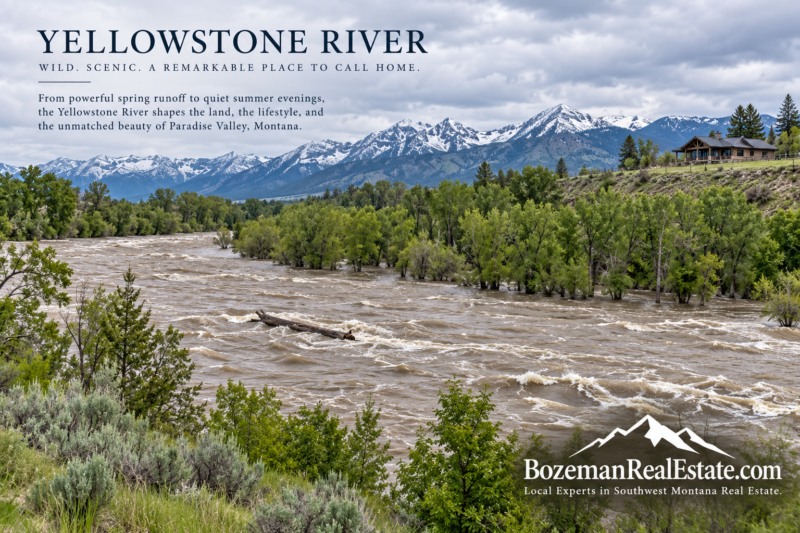
This is the part of living along the Yellowstone River that every buyer should take seriously. Because the Yellowstone is undammed, spring runoff can be dramatic, and the river channel can shift. In June 2022, heavy rain on a late snowpack produced record flooding across the upper Yellowstone. According to the National Weather Service’s June 2022 flood summary, the river at Corwin Springs crested at 13.88 feet, well above the previous 1918 record. The Carbella Bridge washed out. For a time, the Mill Creek and Pine Creek bridges were the only operational river crossings in Paradise Valley, and wells across Park County were submerged or compromised.
That event reshaped the river and how buyers evaluate riverfront property. Before you write an offer, we recommend these checks:
Floodplain mapping. Check where the home, well, and septic sit relative to FEMA flood zones and the county’s floodplain maps. Homes inside a mapped Special Flood Hazard Area typically need flood insurance for a federally backed mortgage.
Elevation and history. Ask what happened to the property in 2022 and 2011. A home on a high bench 30 feet above the river lives very differently from one at water level.
Bank stabilization and permits. Work in or near the river, such as riprap, bank repairs, or a boat ramp, generally requires a 310 permit through the local conservation district, plus county floodplain permits. Unpermitted “fixes” can become a buyer’s problem.
Well and septic. Most valley homes run on private wells and septic systems. Have both inspected and water-tested, especially on low ground.
Access. Confirm whether your driveway or road relies on a bridge that could be cut off during high water.
Water rights are a separate but related question, particularly on acreage with irrigation ditches. Our Paradise Valley Montana water rights buyer’s guide covers what to verify.
Seasons on the River in Paradise Valley
Spring (April–June): Green-up comes fast, calves show up in the pastures, and the Mother’s Day caddis hatch arrives in early May. Runoff typically peaks in late May or June, and the river turns high and off-color.
Summer (July–September): This is peak river season, with clear water, evening hatches, floats, and busy Highway 89 traffic heading to Yellowstone. Long daylight means dinner on the deck at 9 p.m.
Fall (September–November): Cottonwoods turn gold, crowds thin, and brown trout fishing picks up. Many locals call this the valley’s best season.
Winter (December–March): The valley is quiet and snowy, with shelf ice along the banks and elk on the meadows. Wind is a real factor near Livingston, and plowing or four-wheel drive is essential on private roads.
What Yellowstone River Property Costs in Paradise Valley
Riverfront is the most sought-after and the scarcest property type in the valley. Our Paradise Valley MT Real Estate Market Report puts Park County’s overall median sale price at around $575,000 as of March 2026, with average days on market climbing to about 163 days. Riverfront doesn’t follow those averages. Direct Yellowstone River frontage commands the steepest premium in the valley, and it isn’t unusual to see modest homes on riverfront acreage listed near or above $2 million. Larger ranches with frontage, water rights, and outbuildings go well beyond that. Well-priced riverfront parcels also tend to sell faster than the broader market, even while overall days on market run long.
Market statistics and data referenced in this article are sourced from realtor.com and Big Sky MLS. Figures are subject to change and should be independently verified for time-sensitive decisions.
Because Montana is a non-disclosure state, sold prices aren’t public, and a meaningful share of riverfront and ranch trades happen quietly through broker networks. That makes local representation more valuable here than in a typical Bozeman subdivision. You can browse active inventory on our Paradise Valley Montana homes page or the Paradise Valley community real estate page. Buyers comparing river corridors may also want to look at Madison River real estate near Ennis.
Is Living Along the Yellowstone River Right for You?
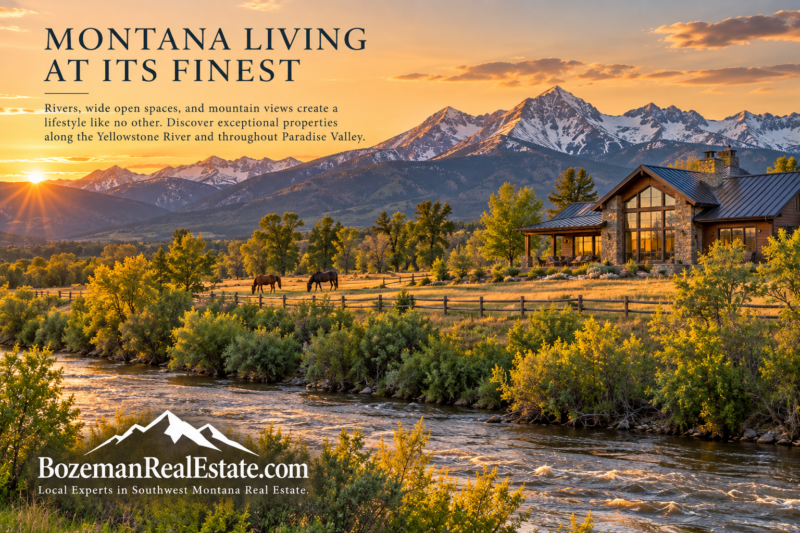
Living along the Yellowstone River suits people who want space, wildlife, and water more than walkability. It rewards owners who respect the river, plan ahead for winter and runoff, and enjoy being a short drive from Yellowstone National Park’s north entrance. It’s a harder fit if you need daily in-town services, a short commute to Bozeman, or complete privacy on the water.
If you’re still exploring, our Moving to Paradise Valley, Montana relocation guide covers schools, services, and logistics. Moving to Livingston, Montana covers the town end of the valley. Buyers relocating to the wider region should also read our Southwest Montana real estate guide.
Working With a Local Yellowstone River Real Estate Team
Riverfront purchases in Paradise Valley raise questions most transactions never touch: floodplain maps, 310 permits, bank condition, water rights, and bridge access. Jean White and Britney White track the Paradise Valley corridor closely, from Livingston to Emigrant to Pray. We can flag riverfront opportunities before they’re widely marketed. Learn more about how we help buyers, or contact us to start a conversation about Yellowstone River property.
Frequently Asked Questions
What is it like living along the Yellowstone River in Paradise Valley?
It’s quiet, scenic, and outdoors-focused. You get daily wildlife, trout water at your door, and big mountain views. The trade-offs are longer drives to services in Livingston and Bozeman, plus the need to plan around spring runoff and winter conditions.
Can the public fish or float past my Yellowstone River property?
Yes. Under Montana’s Stream Access Law, the public can use the river up to the ordinary high-water mark. They cannot cross your private land to reach the water or enter posted land above the high-water mark.
Does the Yellowstone River flood in Paradise Valley?
It can. Because the river is undammed, spring runoff is strong, and the June 2022 flood set records at gauges in the valley. Check floodplain maps, the property’s elevation, and its flood history before buying.
Do I need flood insurance for a Yellowstone River home?
If the home sits in a FEMA-mapped Special Flood Hazard Area and you use a federally backed mortgage, flood insurance is typically required. Even outside mapped zones, many riverfront owners carry it voluntarily.
How much does Yellowstone River property cost in Paradise Valley?
Riverfront is the premium tier of the valley’s market. Park County’s overall median sale price was about $575,000 in early 2026, while riverfront homes on acreage commonly list near or above $2 million, and larger ranches go higher.
Can I build a dock, boat ramp, or riprap on my riverfront?
Work in or near the river generally requires a 310 permit through the local conservation district, along with county floodplain permits. Always confirm what’s permitted before buying if you have plans for the bank.
How far is Paradise Valley riverfront from Bozeman and Yellowstone National Park?
Most riverfront homes in the valley are roughly 45 to 75 minutes from Bozeman and 20 to 45 minutes from Yellowstone’s north entrance at Gardiner, depending on location.
Is Yellowstone River property a good long-term investment?
Riverfront land in Paradise Valley has historically held its value well because supply can’t be created. Pricing still varies widely by frontage, elevation, water rights, and flood exposure.
Stay Ahead of the Paradise Valley Market
Paradise Valley’s inventory is tight and prices move fast when the right home hits the market. Sign up for free monthly Paradise Valley real estate reports and be the first to know about new listings, price shifts, and market trends before they hit the headlines.
Sign Up for Free Paradise Valley Market Reports →
Bozeman Chamber → bozemanchamber.com
Livingston Area Chamber (serving Paradise Valley) → livingston-chamber.com
Stay Ahead of Paradise Valley Market → Paradise Valley Homes for Sale

Homes For Sale In Paradise Valley MT
Leave a Reply