Big Sky Short-Term Rental Investment Guide: Buying a Vacation Rental in Big Sky, MT
By Jean White & Britney White, REALTORS® | Berkshire Hathaway HomeServices Montana Properties | BozemanRealEstate.com
Thinking about buying a Big Sky short-term rental? You aren’t alone. Big Sky draws skiers from Thanksgiving through April and hikers, anglers and Yellowstone visitors all summer. That makes it one of the strongest vacation rental markets in the Mountain West. Two rental seasons, no city-level permit cap, and a steady stream of visitors make a Big Sky vacation rental appealing. But the numbers only work if you understand the 2026 rules: county zoning, HOA covenants, a 12% combined lodging tax that guests pay, and Montana’s new 1.9% property tax rate for second homes. This guide covers all of it and shows which Big Sky neighborhoods suit rental investors.
Get Big Sky Market Reports, Free Every Month
Track home prices, new listings, and inventory trends in Big Sky and the Gallatin Canyon, delivered straight to your inbox. No spam, just the numbers you need before you buy or sell. Sign Up for Free Big Sky Market Reports →
Buying a vacation rental in Big Sky, Montana.
Why Big Sky Short-Term Rentals Attract Investors
Most resort towns have one strong season. Big Sky has two. Winter brings skiers to Big Sky Resort, Moonlight Basin and the private clubs. Summer brings guests heading to Yellowstone’s west entrance, the Gallatin River and the trail systems around Ousel Falls and Beehive Basin. Shoulder seasons are quieter, but the two peaks carry most of the year’s revenue for a well-located Big Sky vacation rental.
Supply is the other half of the picture. Census data shows a large share of Big Sky’s housing stock sits vacant much of the year as seasonal or second homes. That is a big reason Big Sky is so expensive: little land, a lot of outside demand, and few homes for full-time residents.
Big Sky Short-Term Rental Rules: What Investors Need to Know
Big Sky is unincorporated, so the counties set the rules
Big Sky has no city government. The community spans Gallatin and Madison counties, so there is no city short-term rental permit and no city license cap. Rules come from the counties, the state and, often most important, your HOA.
Gallatin County. The county generally defines a short-term rental as a home rented for 30 days or less. The Gallatin Canyon/Big Sky Zoning Regulation lists short-term rentals as a permitted use in many of its residential and commercial districts. The Gallatin City-County Health Department also has public-health and sanitation permit requirements for short-term rentals. Start with the county’s official Gallatin County Short-Term Rental FAQs.
State of Montana. Short-term rental hosts must register for a Public Accommodation License through the Montana Department of Public Health and Human Services, and they must register to collect state lodging taxes.
HOA covenants are the real gatekeeper
This is where most Big Sky rental deals are won or lost. Some condo associations welcome nightly rentals and even run rental programs. Others ban rentals under 30 days or limit how often you can rent. In the Meadow Village area, the Big Sky Owners Association charges an annual short-term rental fee and requires a signed registration form. Before you write an offer, have your agent get the HOA’s covenants, rental policy, dues history and any planned special assessments.
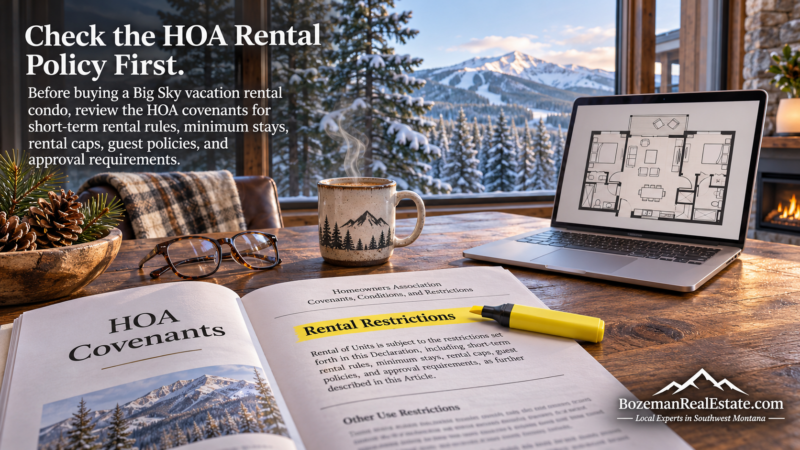
Review HOA rental policies before buying a vacation rental condo in Big Sky, Montana.
Big Sky Resort Tax and Lodging Taxes on Vacation Rentals
Guests, not owners, pay the lodging taxes, but you are responsible for collecting and remitting them. A Big Sky short-term rental inside the resort district collects:
4% Big Sky resort tax: 3% for general community purposes and 1% for voter-approved infrastructure, administered by the Big Sky Resort Area District. Voters extended the resort tax through 2065.
8% Montana lodging tax: a 4% Lodging Facility Use Tax plus a 4% Lodging Facility Sales Tax.
That is about 12% total on each booking. Booking platforms collect some state taxes automatically, but you still need to register with the Big Sky Resort Area District to remit resort tax. Most local property managers handle this filing for owners.
Montana’s New Property Tax Rate for Big Sky Rental Properties
This is the biggest 2026 change for anyone running Big Sky rental property numbers. Under House Bill 231 and Senate Bill 542, Montana now taxes residential property in two groups:
Homesteads and long-term rentals (a primary residence, or a home rented to tenants for 28+ days at a time for at least seven months a year) get tiered rates starting at 0.76%.
Second homes and short-term rentals pay a flat 1.9% rate on their full value.
The state’s own analysis projected that non-homestead properties, including second homes and Airbnb-style rentals, would see a cumulative average increase of about 68%. When you build a pro forma, use the new rate, not the seller’s old tax bill. Tax bills from 2024 and earlier will understate what you’ll pay. Details and enrollment dates are on the Montana Department of Revenue homestead and long-term rental page.
Big Sky Real Estate Market Snapshot for Rental Investors
Big Sky prices sit well above the rest of Montana, so most short-term rental investors start with condos and townhomes rather than single-family homes.
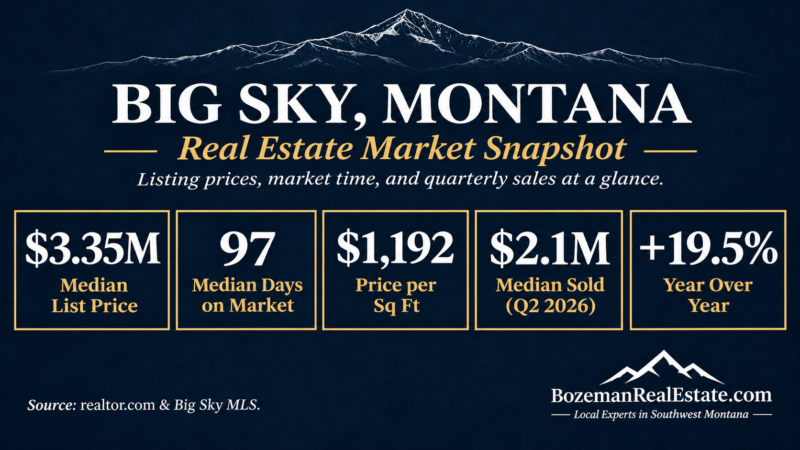
Median listing price (realtor.com, September 2026): about $3.35 million
Median days on market (realtor.com): 97 days
Median list price per square foot (realtor.com): about $1,192
Median residential sold price (Big Sky MLS, Q2 2026): about $2.1 million, up about 19.5% year over year
Median single-family sold price (Big Sky MLS, June 2026): about $3.25 million
Market statistics and data referenced in this article are sourced from realtor.com and Big Sky MLS. Figures are subject to change and should be independently verified for time-sensitive decisions.
Big Sky housing market snapshot using your supplied figures, attributed to realtor.com and Big Sky MLS.
Best Big Sky Neighborhoods for Short-Term Rental Investment
Location decides your nightly rate. Ski access drives winter bookings, and walkability to restaurants and summer events drives summer bookings. Here’s how Big Sky’s inventory sorts for rental investors. Check every association’s rental policy, because covenants differ from building to building.
Hotel condos with on-site rental programs
Hotel condos at the Mountain Village base are the most hands-off kind of Big Sky vacation rental. The resort runs the front desk, housekeeping and booking. Browse Summit Hotel Condos and Shoshone Hotel Condos. The trade-off is a revenue split with the hotel program and less personal use during peak weeks.
Big groups and families book whole homes, especially over the holidays. Single-family subdivisions such as Cascade Subdivision, Spanish Peaks North, Beaver Creek West and Ramshorn View Estates can fit this kind of rental. Check each set of covenants carefully, because single-family associations are often stricter than condo associations. Private club communities have their own rules. See Private Clubs in Big Sky.
How to Run the Numbers on a Big Sky Vacation Rental
A Big Sky short-term rental pro forma should include:
Seasonal revenue, not a yearly average. Model December–March and June–September separately, and assume slow shoulder months in April–May and October–November.
Management fees. Full-service local managers typically take a sizable share of gross bookings. Hotel programs work on a revenue split.
Property tax at 1.9%. Calculate it from the purchase price, not the seller’s old bill.
HOA dues and special assessments. Ask for the association’s reserve study.
Insurance. Short-term rental policies cost more than a standard second-home policy.
Cleaning, linens, supplies, utilities, internet and snow removal.
Your personal-use weeks. Every week you use the property is a week it isn’t earning.
Example only: on a $1.2 million condo, Montana’s 1.9% rate gives a taxable value of $22,800. Your local mill levy then turns that into the actual tax bill, so ask your agent for the levy that applies to the specific property.
Compare winter, summer, and shoulder-season income with vacation rental ownership expenses.
Big Sky Short-Term Rental FAQ
Are short-term rentals legal in Big Sky, Montana?
Yes. Big Sky is unincorporated, so there is no city permit system or license cap. The Gallatin Canyon/Big Sky Zoning Regulation allows short-term rentals in many districts. You still need state and county health permits, lodging tax registration and resort tax registration, and your HOA covenants can prohibit or limit rentals.
What taxes do Big Sky vacation rental guests pay?
Guests in the resort district pay a 4% Big Sky resort tax plus Montana’s 8% lodging taxes, about 12% total. The owner or property manager is responsible for collecting and remitting these.
How much property tax will I pay on a Big Sky short-term rental?
Starting in 2026, Montana taxes second homes and short-term rentals at a flat 1.9% of market value to set taxable value. Your local mill levy is then applied to that number. Homesteads and qualifying long-term rentals get lower tiered rates.
Can I rent my Big Sky condo short-term if the HOA prohibits it?
No. Private covenants can restrict rentals under 30 days even where county zoning allows them. Always review the association’s documents before you make an offer.
What’s the best type of property for a first Big Sky short-term rental?
Many first-time investors choose a condo or hotel condo close to the lifts, because maintenance is simpler and winter demand is strongest. Meadow Village and Town Center condos often do well in summer and come with lower entry prices.
Do I need a property manager for a Big Sky vacation rental?
It isn’t required, but most out-of-state owners use one. A manager handles guest communication, cleaning, snow removal, emergencies and tax filings, which is hard to do from far away in a mountain resort.
Is a long-term rental an option in Big Sky?
Yes, and the tax math differs. A home rented to tenants for 28+ days at a time for at least seven months a year can qualify for Montana’s reduced long-term rental tax rate, and Big Sky has steady demand for workforce housing.
Stay Ahead of the Big Sky Market
Big Sky’s inventory is tight and prices move fast when the right home hits the market. Sign up for free monthly Big Sky real estate reports and be the first to know about new listings, price shifts, and market trends before they hit the headlines. Sign Up for Free Big Sky Market Reports →




Leave a Reply